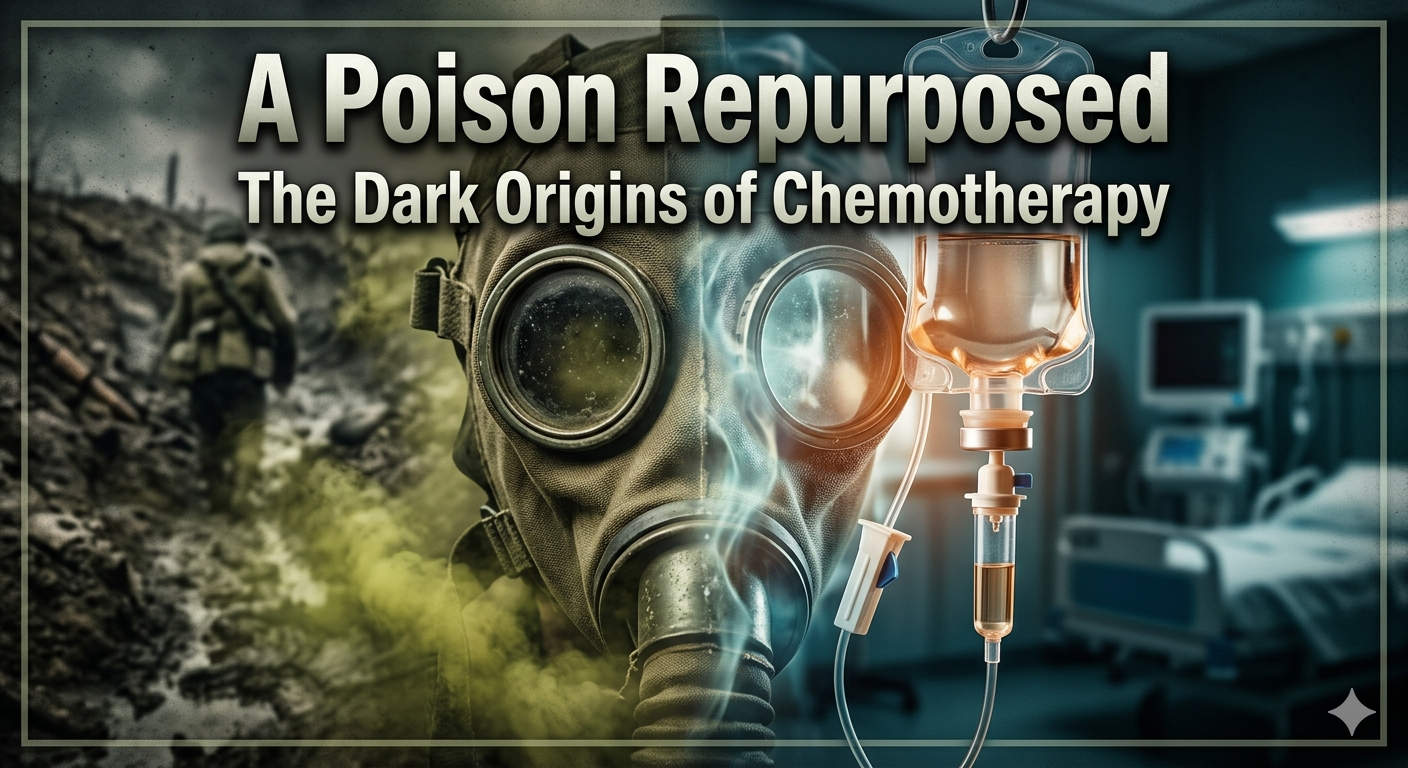
The most widely used cancer treatment in the world began as a weapon. Not metaphorically — literally. The drugs millions of patients still receive today descend, in a direct chemical line, from a poison gas designed to blister lungs, blind eyes, and collapse the bone marrow of soldiers in the trenches of the First World War. Strip away the white coats and the IV bags, and the founding logic of chemotherapy is uncomfortably simple: take something that kills cells indiscriminately, and hope it kills the cancer before it kills the patient.
A Weapon, First and Always
Mustard gas was unleashed by German forces at Ypres in July 1917. Soldiers exposed to it died slowly — lungs filling with fluid, skin sloughing off, immune systems gutted from the inside. Army pathologists noticed a peculiar signature: the gas annihilated bone marrow and lymph nodes, sending white blood cell counts into freefall. In 1919, Edward and Helen Krumbhaar reported that survivors whose counts fell below 5,000 almost never recovered, dying of infections a healthy person would shrug off. This was the chemistry that would, two decades later, be christened “treatment.”
Secrecy and “Substance X”
When World War II began, the US government quietly restarted chemical-weapons research. The dean of Yale School of Medicine signed a classified contract and handed the work to two young pharmacologists on his faculty: Louis Goodman and Alfred Gilman, both Jewish American scientists. They were assigned to study a more stable derivative of mustard gas called nitrogen mustard. It was so sensitive that the compound appeared in their notebooks only as “Substance X.”
Re-reading the Krumbhaars’ WWI reports, Goodman and Gilman made a leap that sounds less like a breakthrough than a calculated bet: if this poison destroyed white blood cells, perhaps it could be aimed at cancerous ones. The hypothesis rested on no selective mechanism — only on the fact that cancer cells, like the bone marrow of gassed soldiers, divide quickly. It was, in essence, a controlled poisoning.
The First Patient: A Brief Reprieve, Then Death
On August 27, 1942, a Polish immigrant known in the records only as J.D. became the first person to receive what we now call chemotherapy. He was dying of lymphosarcoma, his neck so swollen with tumor he could not swallow. Goodman, Gilman, and the surgeon Gustaf Lindskog injected him with Substance X.
For a few weeks it seemed miraculous. The tumors softened and receded.
Then the rest of the story unfolded — the part the textbooks tend to soften. His bone marrow, exactly like the gassed soldiers of WWI, collapsed. His white blood cell count plummeted. The cancer returned, resistant to the drug. J.D. died on December 1, 1942, barely three months after his first injection. Every defining feature of chemotherapy as we still know it — temporary tumor shrinkage, brutal toxicity, drug resistance, relapse, death — was already on display in that first case.
A year later, the Bari disaster confirmed it on a larger scale: German bombers struck an American ship in the Italian port secretly carrying mustard gas bombs, exposing over a thousand people. The military physician sent to investigate watched their immune systems disintegrate over the following days — the same biological catastrophe, multiplied by a thousand bodies.
The Mechanism Nobody Likes to Name
Modern oncologists describe chemotherapy in clinical language: cytotoxic agents, alkylating agents. The clinical language obscures the underlying truth: traditional chemotherapy does not actually know what cancer is. It cannot read DNA or distinguish a malignant cell from a healthy one. What it can do is damage the DNA of any cell that is dividing quickly — and cancer cells happen to divide quickly. Unfortunately, so do the cells of the bone marrow, the gut lining, the hair follicles, the reproductive system, and the immune system.
The side effects are not glitches but direct consequences of the mechanism:
- Hair loss, because follicle cells divide rapidly.
- Nausea, vomiting, and mouth sores, because the digestive lining divides rapidly.
- Anemia, infection, and bleeding, because bone marrow is suppressed — the same effect that killed gassed soldiers in 1917 and J.D. in 1942.
- Infertility, because reproductive cells divide rapidly.
- Secondary cancers, in some patients decades later, because alkylating agents damage DNA broadly — including in cells that survive and later mutate.
The strategy is sometimes called carpet bombing: a treatment so crude it harms nearly everything it touches, succeeding only when the patient tolerates the poison better than the cancer does.
A Legacy Worth Questioning
The founding logic of the field deserves a harder look than it usually gets. Chemotherapy was not designed; it was inherited, repurposed from a chemical weapons program by scientists who had no other tools. Its non-selectivity is not a regrettable flaw; it is the entire mechanism. Patients who lose their hair, their fertility, their immune systems, or their lives to side effects are not suffering an unfortunate accident of treatment — they are encountering, in a softened form, the same catastrophe documented in the harbor at Bari.
The newer generation of cancer therapies — targeted drugs, immunotherapies, monoclonal antibodies — exists precisely because oncology eventually recognized what was wrong with its founding paradigm. The hope is that, a century from now, the descendants of mustard gas will be a chapter in the history of medicine rather than a fixture of its present. For the patients still receiving them, that century cannot come quickly enough.