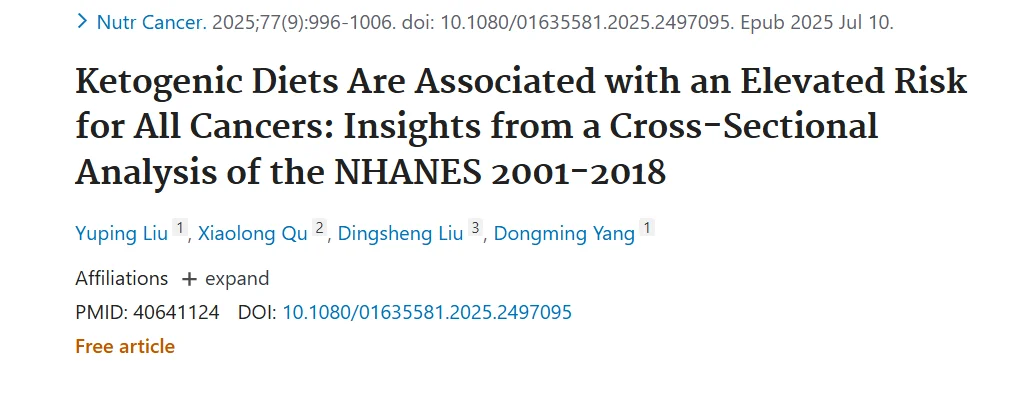
When you hear a headline like “Ketogenic Diets Are Associated with an Elevated Risk for All Cancers,” you’d think researchers actually put people on a ketogenic diet for a meaningful period of time, measured their blood ketones, and tracked cancer markers or outcomes. But that’s not what happened at all.
This paper, published in Nutrition and Cancer (2025), is built on weak methods and misleading assumptions. Let’s break down why it doesn’t prove what the headline claims — and why it’s a poor piece of science.
1- Not a Study of Ketogenic Dieters
This paper did not study people who actually follow ketogenic diets. Instead, it created a “Dietary Ketogenic Ratio” (DKR) based on just two days of food recalls. Participants were asked to remember what they ate yesterday (once in person, once by phone).
That’s it. Two days.
If someone ate steak and eggs for two days, they might be classified as “keto,” even if the rest of their year was pizza and soda. This is not how ketosis works, and it is certainly not how ketogenic diets are practiced clinically.
2- No Measurement of Ketosis
The gold standard for confirming ketosis is blood or urine ketone testing (β-hydroxybutyrate, acetoacetate). This study measured none of that. Instead, it used a 40-year-old formula from epilepsy research to “estimate” whether someone’s diet might produce ketones.
In other words: no ketones were measured, so we don’t even know if anyone in this study was ever in ketosis.
3- Cancer Was Self-Reported
Cancer history was determined by one question:
“Have you ever been told by a doctor or health professional that you had cancer or a malignancy of any kind?”
No medical verification. No information about cancer type, timing, or treatment. Someone who had cancer 20 years before the survey — and then changed their diet — would still be lumped in as “cancer = yes.”
This opens the door to reverse causality: people with cancer may have deliberately changed their diet (e.g., reducing carbs) after diagnosis. That makes it look like “keto causes cancer,” when in reality, cancer may have caused dietary change.
4- Cross-Sectional = No Causality
The NHANES design is cross-sectional. It takes a snapshot of diet and health history at the same time. This means the study cannot establish cause and effect.
Yet the authors frame their conclusion as if ketogenic diets increase cancer risk. That is scientifically dishonest. At best, they found an association that could easily be explained by confounding.
5- Confounding Factors Everywhere
Even after adjustments, the “high ketogenic ratio” group had:
More smokers
Higher BMI
Lower intake of vitamins and fiber
These are well-known cancer risk factors. The small odds ratios reported (about 1.2–1.3) are weak and could easily be explained by these confounders.
6- Contradicts Better Evidence
Clinical trials and systematic reviews have shown ketogenic diets can:
Lower insulin and glucose
Reduce inflammation
Improve weight and metabolic markers in cancer patients
In some cases, enhance treatment responses
None of this was discussed in depth. The authors cherry-picked mechanisms suggesting harm, while ignoring the broader body of evidence showing potential benefit.
7- The Numbers Don’t Even Make Sense
The authors report that cancer risk rises only below a DKR of 0.44, but not above it. Translation: people who were “more ketogenic” had no increased risk. So the scary headline — “keto increases cancer risk” — is not even supported by their own data.
Final Word
This study does not prove that ketogenic diets increase cancer risk. It doesn’t even study ketogenic diets. It studies two random days of eating, runs them through an outdated formula, and compares that to self-reported cancer history.
That’s not science — that’s statistical storytelling.
Ketogenic diets should continue to be evaluated in real-world clinical trials with proper biomarkers, not dismissed based on flawed cross-sectional snapshots. Until then, headlines like this do more to mislead the public than to advance science.